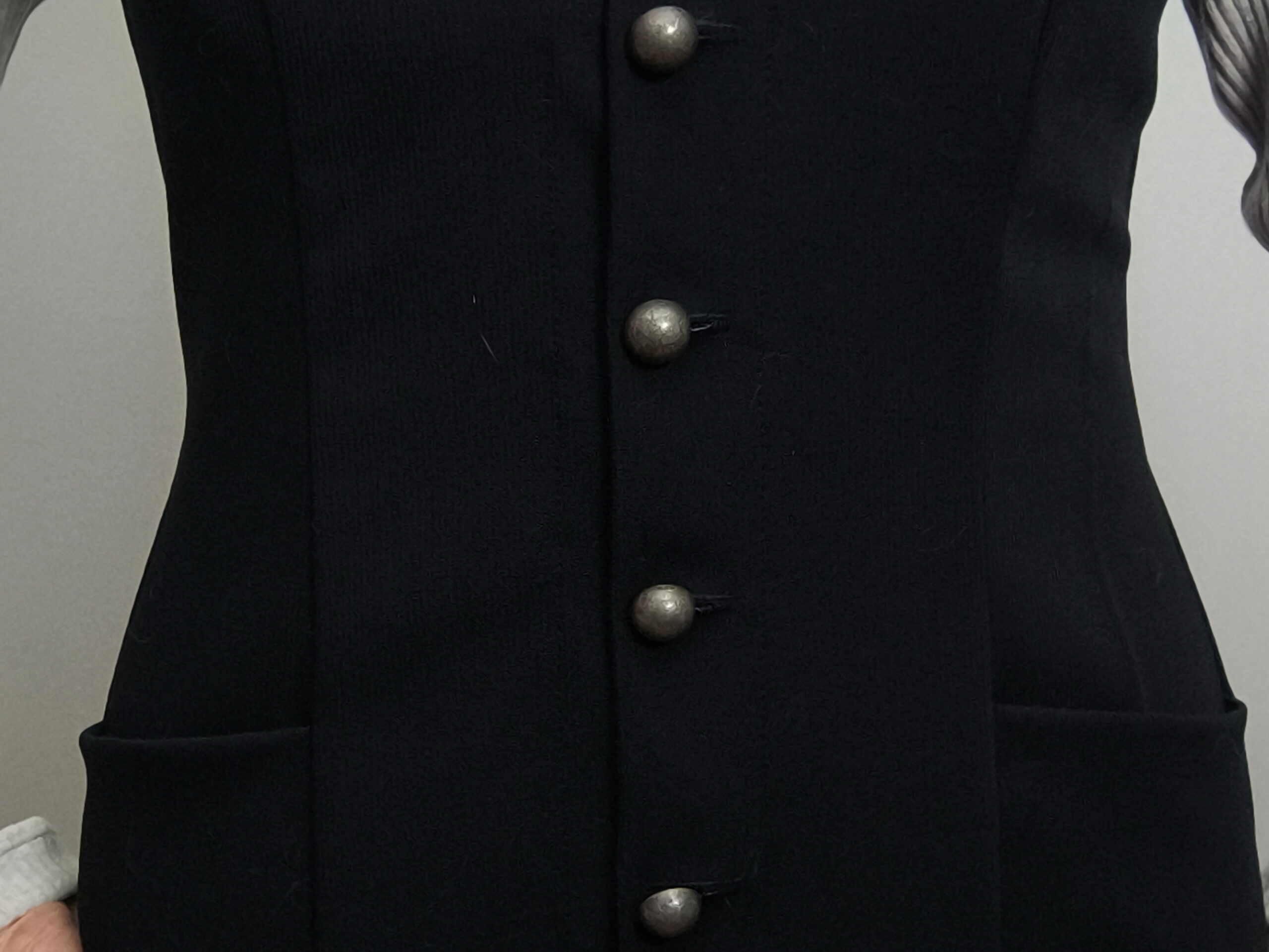
After having sewn the wonderful Shimla jacket, it’s the Elmstead pinafore* that I tested.

Elmstead* is the epitome of the pinafore dress, with its front buttons and cute princess seams for shaping.
- Elmstead* pattern
- Woven fabric with some stretch
- Suitable fusible interfacing
- Binding (homemade or store-bought)
- Buttons

The Elmstead pattern
I’d say that the Elmstead dress* is a quick pattern when it comes to either sewing or putting it on!
I love the shape it has thanks to both the front and back princess seams, but you can add a back half-belt.

This is an unlined dress and neckline and armholes are finished with invisible binding.
Sizes range from US 00 to 40, with cups going from A to DD.
Elmstead* is to be worn over a t-shirt or whatever top you want. The reason behind that is that the armscyes are drafted for having a layer beneath the dress. If not wearing a top, you might have troubles in the upper bust area and at the side of the armholes.


2026’s little black dress!
I used to sew a Little Black Dress every year, but I stopped a few years ago. So let’s start again with this pinafore dress.

I had this fabric of unknown content sitting on my shelves. Being a Minerva Brand Ambassador*, I get fabrics every month so what I had before becoming an Ambassador needs to be used as well!
This is probably a polyester, with a slight texture. It has mechanical stretch which is enough for this pattern. Something around 5%, I think.
I cut a muslin in size 8, cup B. The fit check showed me that:
- I had too much fabric at the back –> too long at center back –> sway-back adjustment
- armholes down on the top of the arm –> narrow shoulder + low-base neck –> J.Stern’s alteration for low-base neckline
Once the laterations were transfrred to the pattern pieces, I cut into my fabric and did my lengths of binding.

Let’s be honest: I hate sewing invisible binding. I’m not good at it. I’ve never ever understood how it was done on the armholes. But, that time, something clicked and I managed to get it right! And, trust me, I was the type of girl who would prefer to draft a facing rather than sewing invisible bias.
If you’re starting using the invisible binding method, cut wider binding that advised. It will be easier to manipulate. I used some polyester lining as my bias and it was great.

You’re instructed to use 1-cm buttons, that I didn’t have so mine are 18-mm and they’re great.
After a few days wearing this dress, I still need to address some issues at the upper back. It’s still to wide and I wonder if I shouldn’t slash into the yoke horizontally and take some cms off, adding them back in the armpit area.
I wore two other ITS patterns as layers: one is a Venado* in burgundy and the other is a bicolor Hepburn turtleneck*.
Sewing bags was a God-send: I had the right size of buckle for the half-belt!
I like how it can shape the waist.